Classification > Superfamily
Membracoidea
> Family
Cicadellidae
> Subfamily
Typhlocybinae
> Tribe
Typhlocybini
> Genus
Edwardsiana
 Edwardsiana crataegi (Douglas, 1876)
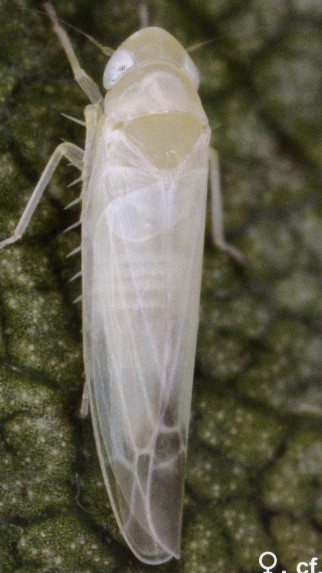
Edwardsoama crataegi, dorsal view. Image extracted from Kunz et al. 2011 a.
Geographic distribution
Distribution
Insects with no economic damage registered
- Argentina
- Buenos Aires
- Argentina
- Chubut
- Mendoza
- Río Negro
Other distribution
Australia (Froggatt, 1918), Tasmania, New Zealand, Europe and the USA (Christian, 1953), and Chile (Linnavuori, 1954).
- Empoasca australis Froggatt, 1918
- Empoasca bifidella Linnavuori & DeLong, 1977
- Typhlocyba froggatti Baker, 1925
- Empoa (Typhlocyba) malini DeLong, 1926
- Typhlocyba oxyacanthae Ribaut, 1931
- Typhlocyba xanthippe McAtee, 1926
The damage caused by feeding from the leaf mesophyll consists of chlorotic spotting followed by yellowing, distortion, and premature leaf drop (Charles, 1996). The damage first occurs in the lower and central areas of the plant, then spreads to the rest (Burnip et al., 1999). Seedlings may lose all their leaves, with a consequent reduction in vigor. They do not feed on the fruit; however, they deposit excrement that is difficult to remove and affects commercial quality (Charles, 1996).
Regarding natural enemies, Anagrus sp. (Hymenoptera Mymaridae) was recorded parasitizing eggs (González, 1989; Prado, 1991; Artigas, 1994; Legner, 2000; Charlín, 2003) and Aphelopus typhlocybae Muesebeck (Hymenoptera, Dryinidae) parasites adults (Dumbleton, 1937).
Regarding natural enemies, Anagrus sp. (Hymenoptera Mymaridae) was recorded parasitizing eggs (González, 1989; Prado, 1991; Artigas, 1994; Legner, 2000; Charlín, 2003) and Aphelopus typhlocybae Muesebeck (Hymenoptera, Dryinidae) parasites adults (Dumbleton, 1937).
From the 1940s onwards, this species has been mentioned as causing damage in fruit-growing areas of Argentina (Christensen, 1940; Torres, 1946), particularly to plantations of apple trees (Malus domestica Borkh), plum trees (Prunus domestica L.), pear trees (Pyrus communis L.) and elm trees (Ulmus L.), and cherry (Prunus avium L.) (Bado, 2017).
- DUMBLETON L. J. 1937. Apple leaf-hopper investigations. The New Zealand Journal of Science and Technology, 18, 866-877.
- CHRISTENSEN J.R. 1940. Un nuevo enemigo de los manzanos en la Argentina: Typhlocyba froggatti, Baker. Revista de la Sociedad Entomológica Argentina, 10 (3), 298-303.
- TORRES B.A. 1946. Homópteros (Auquenorrincos) Perjudiciales en Nuestro País. Boletín de la Facultad de Agronomía. Universidad Nacional de La Plata. Argentina, 38 pp.
- GONZÁLEZ R. 1989. Insectos y Ácaros de Importancia Agrícola y Cuarentenaria en Chile. Ograma. Santiago, Chile, 310 pp.
- PRADO E. 1991. Artrópodos y sus Enemigos Naturales Asociados a Plantas Cultivadas en Chile. Boletín Técnico Nº 169. Instituto de Investigaciones Agropecuarias, INIA. Santiago, Chile, 207 pp.
- ARTIGAS J. 1994. Entomología económica. Insectos de interés agrícola, forestal, médico y veterinario (nativos, introducidos y susceptibles de ser introducidos). Concepción, Chile: Universidad de Concepción.
- CHARLES J. 1996. Can buprofezin control Froggatts apple leafhopper, Edwardsiana crataegi?. Proceedings of the New Zealand Plant Protection Conference, 49: 81-84.
- BURNIP G., CHARLES J., SHAW P., SUCKLING D., THOMAS W., TOMKINS A., WALKER J., WEARING H. 1999. Bug Key. Insects and mites of pipfruit. Froggatt´s apple leafhopper. www.hortnet.co.nz/key/keys/info/falinfo.htm (Cons. 17/05/2006).
- LEGNER E. 2000. Biological and integrated pest control Apple Leafhopper, Edwardsiana froggatti (Baker) Hemiptera, Cicadellidae. http://faculty.ucr.edu/~legneref/biotact/ch-4.htm
- CHARLÍN R. 2003. Langostinos: Plaga de importancia actual en frutales desde la Región Metropolitana a la VIII Región. Aconex, 79, 5-9.
- CATALANO, M. I., PARADELL, S. L., & MARINO DE REMES LENICOV, A. M. 2009. Consideraciones taxonómicas y biológicas sobre Edwardsiana froggatti (Baker), la chicharrita amarilla del manzano (hemiptera-auchenorrhyncha-cicadellidae). Interciencia, 34 (6), 424-427.
- KUNZ G., NICKEL H. & NIEDRINGHAUS R. 2011 (a). Fotoatlas der Zikaden Deutschlands: photographic atlas of the planthoppers and leafhoppers of Germany. Wissenschaftlich Akademischer Buchvertrieb-Fründ.
- BADO S.G. 2017. Guía práctica para el manejo sanitario del cultivo de cerezo: región Patagonia Sur, Argentina. Ediciones INTA. ISBN 978-987-521-888-8
