Classification > Superfamily
Membracoidea
> Family
Cicadellidae
> Subfamily
Typhlocybinae
> Tribe
Typhlocybini
> Genus
Eupteryx
 Eupteryx decemnotata Rey, 1891
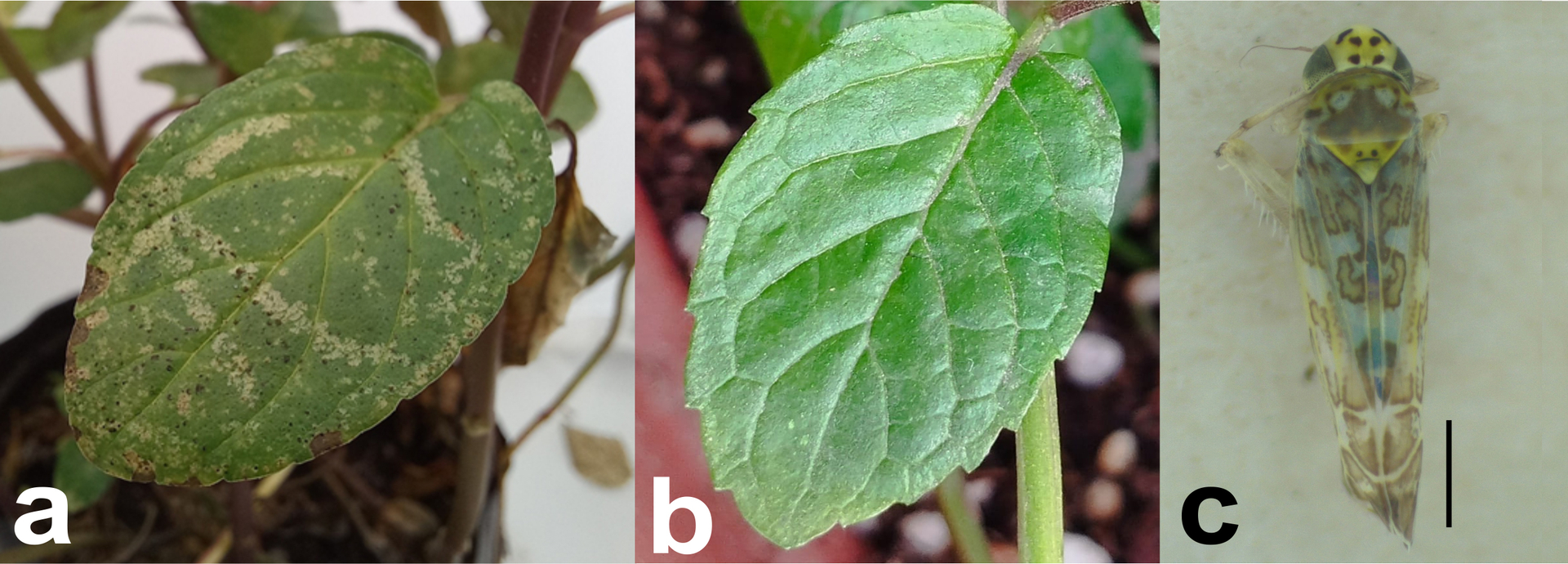
a) damaged leaf; b) healthy leaf; c) adult. Pereyra et al. 2025. New record of Eupteryx decemnotata (Hemiptera: Cicadellidae) in Argentina. Biological traits and description of the female and its immature stages
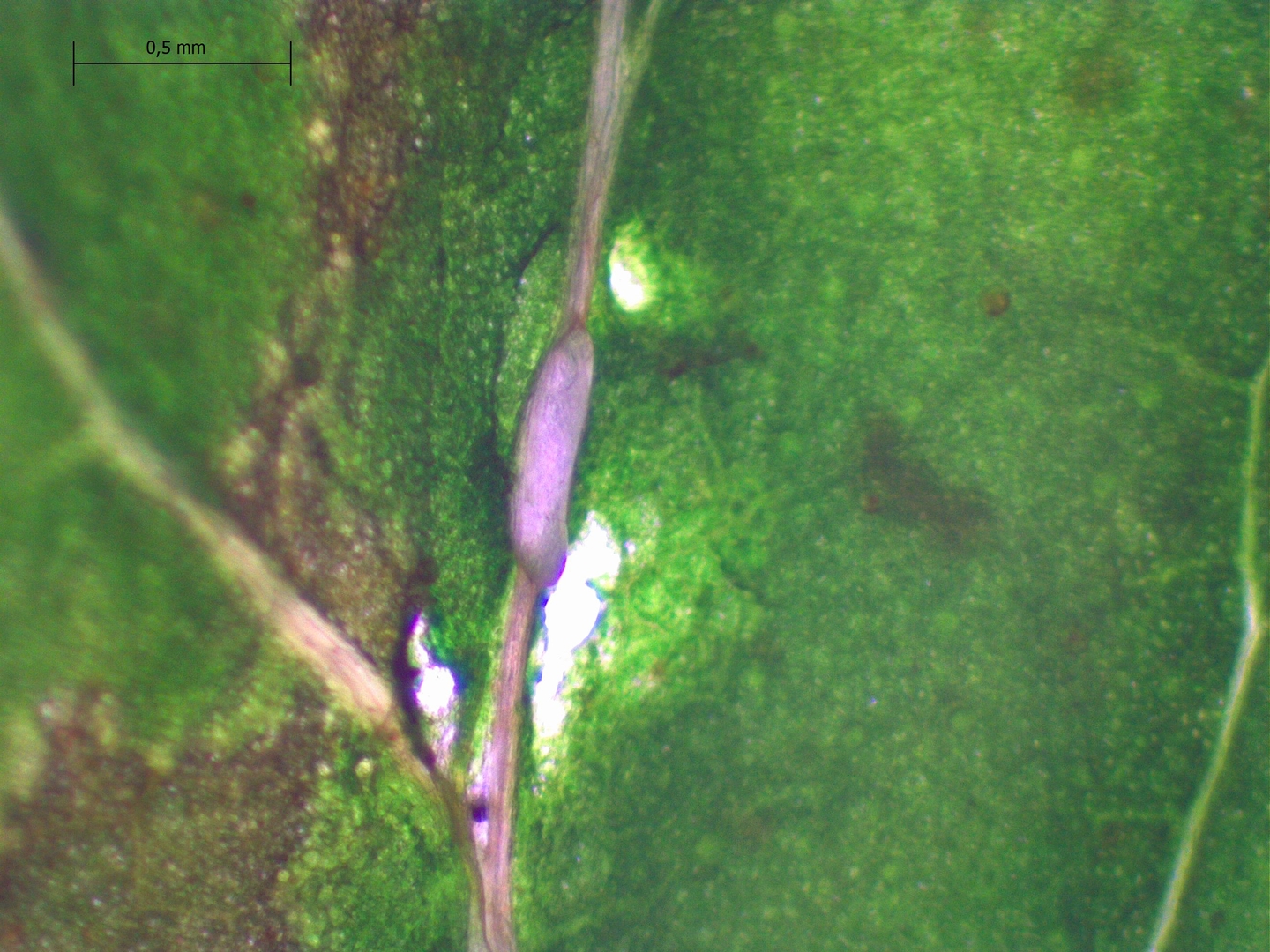 Geographic distribution
Distribution
Harmful insects causing direct damage to crops (feeding/oviposition)
- Argentina
- Buenos Aires
- Mendoza
Other distribution
Tunisia, Turkey, Greece, Italy, Portugal, France, Germany, Austria, Poland, The Netherlands, Czech Republic, Slovakia, Hungary, Switzerland, Ireland, United Kingdom, Sweden, Filand, Denmark, United States and Japan (https://hoppers.speciesfile.org/otus/47273/overview retrieved on 2025-12-18)
- Eupteryx putoni var. 10-notata [sic] Rey, 1891
- Eupteryx decemnotata var. litterata Ribaut, 1936
- Eupteryx lombardi Melichar, 1896
- Eupteryx decemnotata var. trochlearis Ribaut, 1936
- Eupteryx decemnotata var. turbatrix Ribaut, 1936
Eupteryx decemnotata is a species native to the Mediterranean region, from where it spread to other European countries and even reached several states in the United States (Nickel & Holzinger, 2006; Rung et al., 2009; Rung et al., 2009; Ciafré & Barringer, 2017). It was first recorded in Argentina in the province of Mendoza (De Borbón et al., 2022) and later in Buenos Aires (Pereyra et al., 2025).
Like other typhlocybins, it feeds on the chloroplasts of leaf mesophyll cells, causing chlorotic spots on the leaves, known as stippling (Pollard, 1968). This species has been recorded as causing significant damage to aromatic ornamental plants in Tunisia (Chaieb et al., 2012) and to oregano crops in Turkey and Greece (Arslan et al., 2012). At high population densities, the damage intensifies and can eventually lead to the death of the host plant (Nickel and Holzinger 2006; Rung et al. 2009).
Regarding its biological parameters, laboratory studies indicate that the immature stage (from egg to adult) lasts approximately 29 days, with the fifth nymphal stage being the longest (Pereyra et al. 2025).
Like other typhlocybins, it feeds on the chloroplasts of leaf mesophyll cells, causing chlorotic spots on the leaves, known as stippling (Pollard, 1968). This species has been recorded as causing significant damage to aromatic ornamental plants in Tunisia (Chaieb et al., 2012) and to oregano crops in Turkey and Greece (Arslan et al., 2012). At high population densities, the damage intensifies and can eventually lead to the death of the host plant (Nickel and Holzinger 2006; Rung et al. 2009).
Regarding its biological parameters, laboratory studies indicate that the immature stage (from egg to adult) lasts approximately 29 days, with the fifth nymphal stage being the longest (Pereyra et al. 2025).
It is an oligophagous species that feeds on the mesophyll cells of plants belonging to the Lamiaceae family, such as lemon balm (Melissa officinalis L.), oregano (Origanum vulgare L.), lesser calamint (Calamintha nepeta Savi), rosemary (Rosmarinus officinalis L.), hyssop (Hyssopus officinalisL.), peppermint (Minthostachys mollis Griseb.), basil (Ocimum basilicum L.), thyme (Thymus vulgaris L.) and common sage (Salvia officinalis L.) (Mazzoni & Conti 2006, Nickel & Holzinger 2006, Lubiarz & Musik 2015).
- POLLARD D. G. 1968. Stylet penetration and feeding damage of Eupteryx melissae Curtis (Hemiptera, Cicadellidae) on sage. Bull Entomol Res 58 (1), 55-71.
- MAZZONI V. & CONTI B. . 2006. Eupteryx decemnotata Rey (Hemiptera Cicadomorpha Typhlocybinae), important pest of Salvia officinalis (Lamiaceae). Acta Horticola, 723, 453-458.
- NICKEL H. & HOLZINGER W. E. 2006. Rapid range expansion of Ligurian leafhopper, Eupteryx decemnotata Rey, 1891 (Hemiptera: Cicadellidae), a potential pest of garden and greenhouse herbs, in Europe. Russian Entomological Journal, 15 (3), 295-301.
- RUNG A., HALBERT S. E., ZIESK D. C. & GILL R. J. 2009. A leafhopper pest of plants in the mint family, Eupteryx decemnotata Rey (Hemiptera: Auchenorrhyncha: Cicadellidae), ligurian leafhopper, new to North America. Insecta Mundi, 88, 1-4.
- ARSLAN M., UREMIS I. & DEMIREL N. . 2012. Effects of sage leafhopper feeding damage on herbage colour, essential oil content and compositions of Turkish and Greek oregano. Exp Agric 48, 428-437.
- CHAIEB I., BOUHACHEM-BOUKHRIS S. & NUSILLARD B. 2012. Eupteryx decemnotata Rey: a New Pest for Aromatic Plants in Tunisia. Int Symp Med Aromat Plants, 997, 215-218.
- LUBIARZ M. & MUSIK K. 2015. First record in Poland of the Ligurian leafhopper, Eupteryx decemnotata Rey 1891 (Cicadomorpha, Cicadellidae)–an important pest of herbs. ournal of Plant Protection Research, 55 (3), 324-326.
- CIAFRÉ, C., & BARRINGER, L. . 2017. First Record of the Ligurian Leafhopper, Eupteryx decemnotata Rey (Hemiptera: Cicadellidae) in Pennsylvania. Insecta Mundi, 576, 1-2
- DE BORBÓN C. M., CATALANO M. I. & D’INNOCENZO S. H. 2022. Primer registro de Eupteryx decemnotata (Cicadellidae: Typhlocybinae) en la Argentina. Revista de la Sociedad Entomológica Argentina, 81(2), 60-62.
- PEREYRA M., PARADELL S., LUFT ALBARRACÍN E. 2025. New record of Eupteryx decemnotata (Hemiptera: Cicadellidae) in Argentina. Biological traits and description of the female and its immature stages. Anais da Academia Brasileira de Ciências, 97 (4), e2025027.
