Classification > Superfamily
Membracoidea
> Family
Cicadellidae
> Subfamily
Deltocephalinae
> Tribe
Macrostelini
> Genus
Dalbulus
 Dalbulus maidis (De Long & Wolcott, 1923)
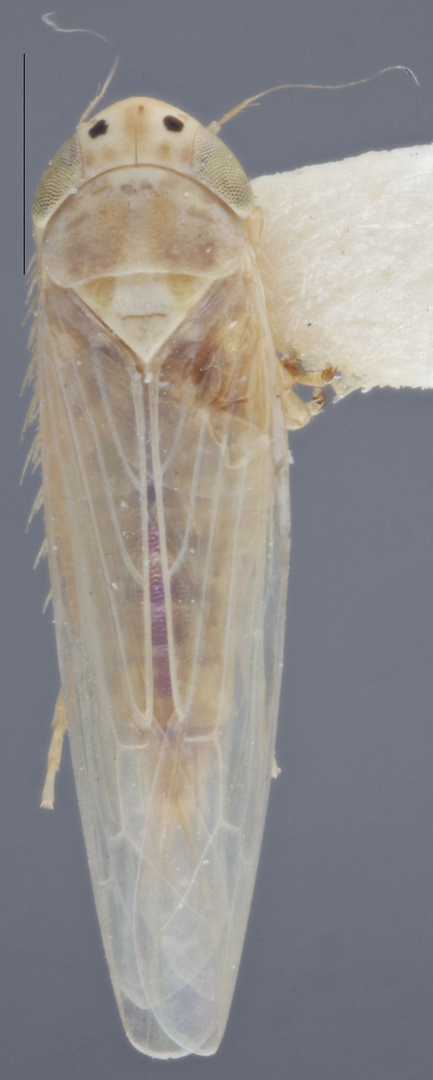
Dorsal view. Photo taken from World Auchenorrhyncha Database (WAD) ©2019. Created by Michelle Kohler. License: CC0 1.0
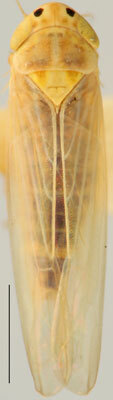
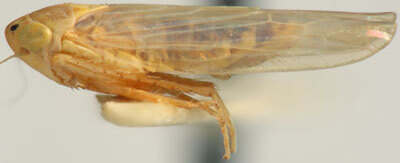 Geographic distribution
Distribution
Harmful insects, vectors of phytopathogens; under official surveillance
- Argentina
- Buenos Aires
- Catamarca
- Chaco
- Córdoba
- Entre Ríos
- Formosa
- Jujuy
- Salta
- Santa Fe
- Santiago del Estero
- Tucumán
Other distribution
Endemic to subtropical and tropical areas of America. California (USA), Central America, Caribbean Islands, and South America up to the north and central area of Argentina. In the southwest of Mexico, considered the center of origin of Dalbulus (Marino de Remes Lenicov & Paradell 2012). United States, Cuba, Dominican Republic, Jamaica, Puerto Rico, Nicaragua, Costa Rica, Guatemala, Panama, Colombia, Venezuela, Peru, and Brazil (Triplehorn & Nault 1985, Nault 1990).
- Baldulus maidis Oman, 1948
- Cicadula maidis in Wolcott, 1923b: 265.
Dalbulus maidis represents one of the main pests of corn in tropical and subtropical areas, including the north of Argentina. It is a vector of four pathogens: 1) Spiroplasma kunkelii, causing the disease Corn Stunt Spiroplasma (CSS) 2) Maize phytoplasma, caused by Candidatus Phytoplasma asteris, causing the disease Maize bushy stunt phytoplasma (MBSP) 3) Maize rough dwarf virus (MRFV) 4) Maize striate mosaic virus (Mastrevirus, Geminiviridae). The first three cause maize stunting, an endemic disease and the most important one in northern Argentina. Once the sharpshooters acquire the pathogen, they remain infectious throughout their entire life.
It is a phytophagous species, practically monophagous or specialist, as it feeds almost exclusively on plants of the genus Zea, including corn (Z. mays L.) and its wild ancestors (teosintes). It is only capable of completing its development and reproducing on these plant species.
In Argentina, it is the most common species in cornfields north of the 30ºS parallel (Paradell et al. 2001, Remes Lenicov & Paradell 2012).
It is a phytophagous species, practically monophagous or specialist, as it feeds almost exclusively on plants of the genus Zea, including corn (Z. mays L.) and its wild ancestors (teosintes). It is only capable of completing its development and reproducing on these plant species.
In Argentina, it is the most common species in cornfields north of the 30ºS parallel (Paradell et al. 2001, Remes Lenicov & Paradell 2012).
Zea maidis Schrader
Tripsacum sp.
Beta vulgaris L. var. rapacea (Koch) Allen (Oman, 1948)
Tripsacum sp.
Beta vulgaris L. var. rapacea (Koch) Allen (Oman, 1948)
- OMAN, P.N. 1948. Distribution of Dalbulus maidis (Delong & Wolcott) (Homoptera - Cicadellidae). Proceedings of the Entomological Society of Washington 50, 34.
- TRIPLEHORN, B. W., & NAULT, L. R . 1985. Phylogenetic classification of the genus Dalbulus (Homoptera: Cicadellidae), and notes on the phylogeny of the Macrostelini. Annals of the Entomological Society of America, 78 (3), 291-315.
- NAULT, L. R. 1990. Evolution of an insect pest: maize and the corn leafhopper, a case study. Maydica, 35 (2), 165-175.
- PARADELL, S., VIRLA, E., TOLEADO, A. . 2001. Leafhoppers species richness and abundance on corn crops in Argentina (Insecta-Hemiptera-Cicadellidae). Boletín de Sanidad Vegetal de Plagas, Madrid, España. 27 (4), 465-475.
- REMES LENICOV, A. M. M. DE; PARADELL, S. . 2012. Enfermedades del maíz producidas por virus y Mollicutes en Argentina. Morfología y Biología de especies vectoras de virus y mollicutes al maíz en Argentina (Insecta: Hemiptera: Cicadomorpha, Fulgoromoprha) Cap. X. (Eds: M.P Gimenez Pecci, I. G. Laguna & S. Lenardón) Ediciones INTA, Bs. As., 1º edición, 200 pp
- ALONSO, M., PARADELL, S., VIGLIANCHINO, L. E., & VIRLA, E. 2023. Hallazgo de la chicharrita Dalbulus maidis, vector del “achaparramiento del maíz”, en el cinturón hortícola de Gral. Pueyrredon. Estación Experimental Agropecuaria Balcarce, INTA, 1-7.
