Classification > Superfamily
Membracoidea
> Family
Cicadellidae
> Subfamily
Typhlocybinae
> Tribe
Dikraneurini
> Genus
Typhlocybella
 Typhlocybella maidica Catalano, Paradell & Remes Lenicov, 2009
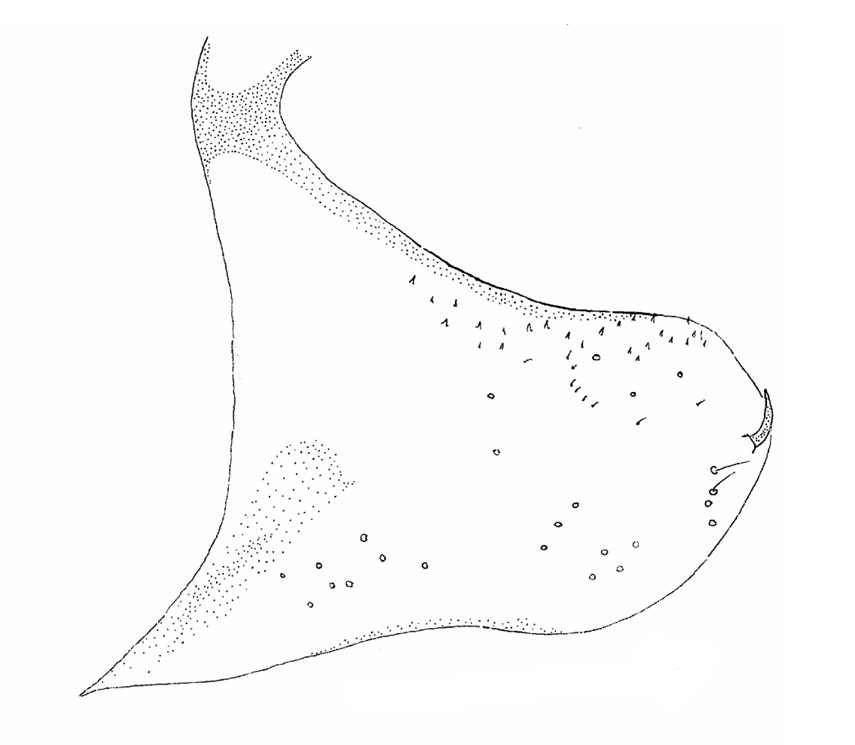
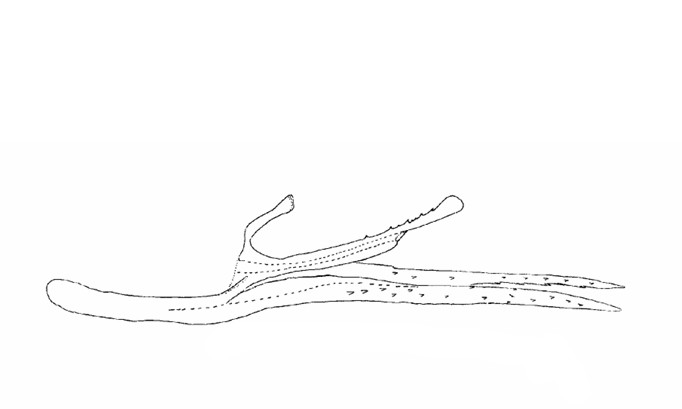
Typhlocybella maidica, pygofer. Image extracted from Catalano et al. 2012.
 Geographic distribution
Distribution
Insects with no economic damage registered
- Argentina
- Tucumán
- Argentina
- Buenos Aires
- Córdoba
- Mendoza
Other distribution
The damage caused by this leafhopper consists of chlorotic areas aligned in a zigzag pattern on both leaf epidermises, resulting from the loss of chloroplasts from the mesophyll cells and the parenchyma sheath surrounding the vascular bundle, as well as a morphological alteration of those present in the sheath. Salivary deposits were also observed, particularly associated with the phloem. T. maidica, like the other typhlocybins, feeds mainly on the contents of mesophyll cells, using a feeding strategy known as "cell-rupturing" (Brentassi et al. 2010).
Maize (Zea mays L.), sorghum (Sorghum vulgare L.), and crabgrass (Digitaria sanguinalis (L.)) (Brentassi et al. 2010)
- CATALANO M.I., PARADELL S. & MARINO DE REMES LENICOV A.M. 2009. Typhlocybella maidica (Hemiptera: Cicadellidae: Typhlcybinae: Dikraneurini), new species from Argentina. Zootaxa, 2118, 65-68.
- BRENTASSI M.E, CATALANO M.I., PARADELL S. & REMES LENICOV A.M.M. DE. 2010. Caracterización de Typhlocybella maidica (Hemiptera: Cicadellidae) y descripción del daño producido en plantas de maíz y gramíneas asociadas en la Argentina. Revista de la Sociedad Entomológica Argentina 69, 57-64
- CATALANO M.I., PARADELL S.L. & DE REMES LENICOV A.M.M. 2012. Revision of the genus Typhlocybella Baker, 1903 (Hemiptera: Cicadellidae: Typhlocybinae: Dikraneurini) and description of a new species from Argentina. Zootaxa, 3164, 57-63.
