Classification > Superfamily
Membracoidea
> Family
Cicadellidae
> Subfamily
Ledrinae
> Tribe
Xerophloeini
> Genus
Xerophloea
 Xerophloea viridis (Fabricius, 1794)
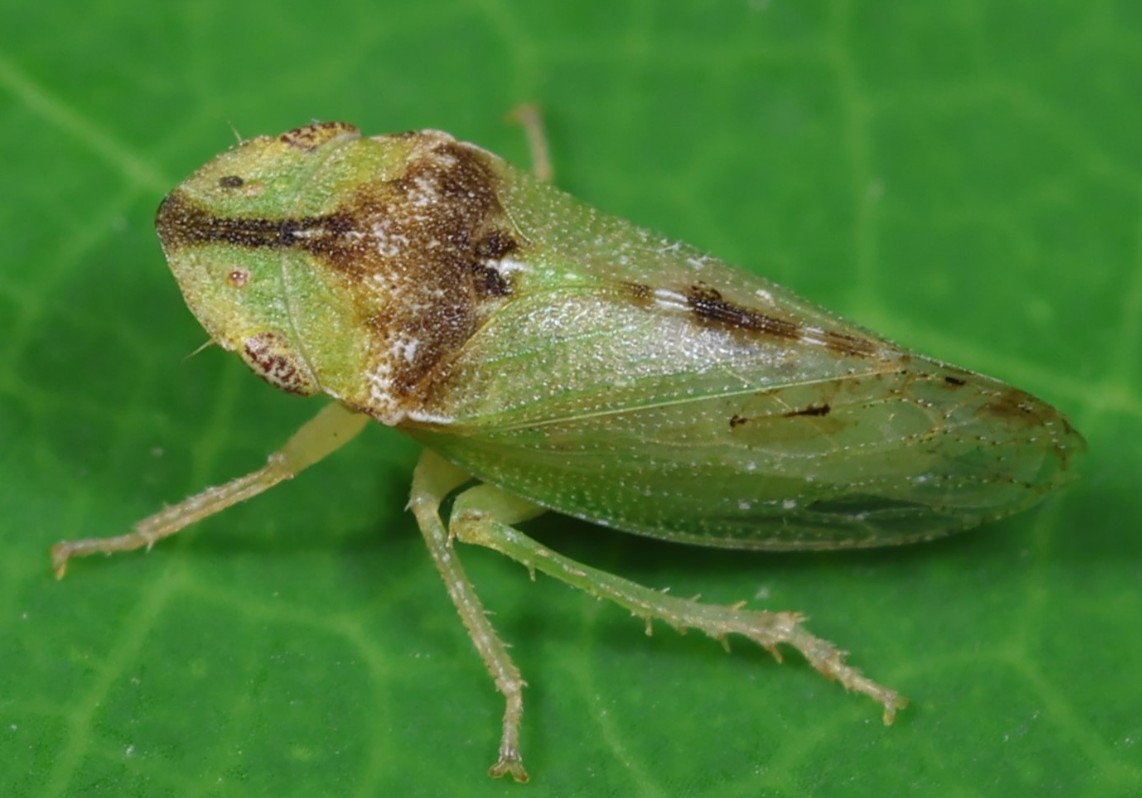
Xerophloea viridis, male, dorsal view. Photo taken by Rob Van Epps (https://auth1.dpr.ncparks.gov/bugs/view_1.php?id=14365)
 Geographic distribution
Distribution
Insects with no economic damage registered
- Argentina
- Buenos Aires
- Catamarca
- Córdoba
- Entre Ríos
- La Rioja
- Mendoza
- Misiones
- Neuquén
- Río Negro
- Salta
- San Juan
- Santa Fe
- Tucumán
Other distribution
United States, Mexico, Peru, Venezuela, Brazil, Bolivia (Paradell, 1995).
Bennett & Munck (1946) conducted trials of Yellow Wilt transmission in sugar cane in Argentina with X. viridis, but this species was not identified as a vector (Nielson, 1962). Furthermore, although this species feeds and reproduces on various cultivated plants, it is not considered a pest (Luft Albarracín & Aquino, 2014).
Natural enemies: Anagrus breviphragm Soyka (Hymenoptera: Mymaridae) (Luft Albarracin et al., 2009) and Polynema haitianum Dozier (Hymenoptera: Mymaridae) (Luft Albarracín & Aquino, 2014), egg parasitoids; Anteon tucumanense Olmi & Virla (Hymenoptera: Dryinidae) (Olmi & Virla, 2008), parasitoid of nymphs and adults.
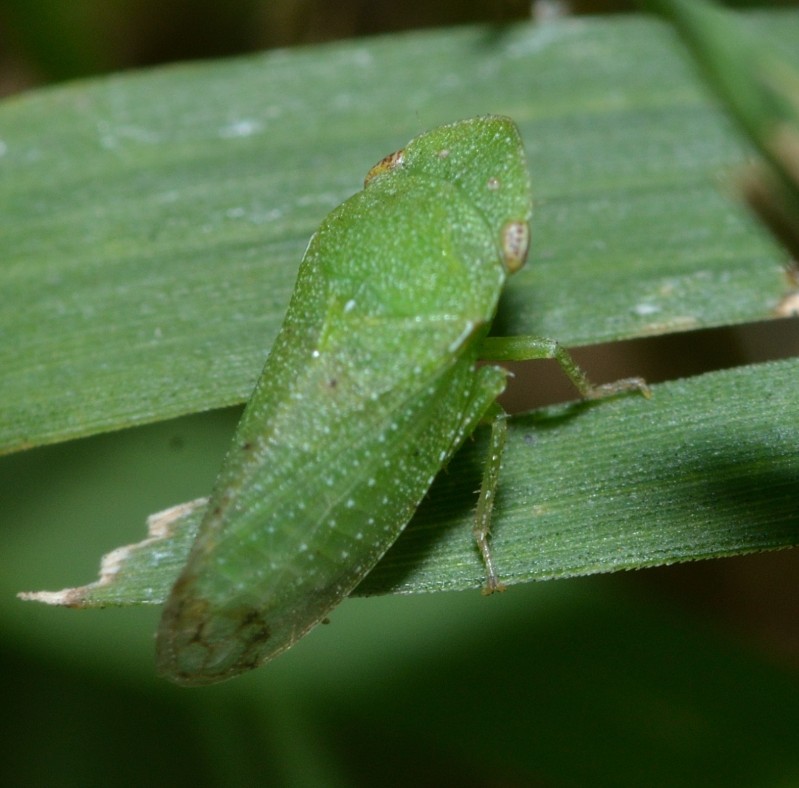
As can be seen in the images, this species exhibits sexual dimorphism: the male has a brown dorsal line on the crown, while the female is entirely green, without any line.
Natural enemies: Anagrus breviphragm Soyka (Hymenoptera: Mymaridae) (Luft Albarracin et al., 2009) and Polynema haitianum Dozier (Hymenoptera: Mymaridae) (Luft Albarracín & Aquino, 2014), egg parasitoids; Anteon tucumanense Olmi & Virla (Hymenoptera: Dryinidae) (Olmi & Virla, 2008), parasitoid of nymphs and adults.
As can be seen in the images, this species exhibits sexual dimorphism: the male has a brown dorsal line on the crown, while the female is entirely green, without any line.
Maize (Zea mays), barley (Hordeum vulgare), wheat (Triticum aestivum), sugar cane (Saccharum sp.), sweet potato (Ipomea batatas, tomato (Lycopersicum escuientum), lettuce (Lactuca sativa), yerba de San José (Ageratum conyzoides), Digitada decubens Stent, garlic (Allium sativum), Vicia villosa, alfalfa (Medicago sativa ), orange (Citrus sinensis) and weeds (Zanol & Menezes, 1982; Paradell, 1995; Paradell et al., 2000; Ott & Carvalho, 2001; Remes Lenicov et al., 2004; Luft Albarracin et al., 2008; Meneguzzi, 2009; Catalano, 2011; Logarzo et al., 2012; Paradell et al., 2014; Alvarez et al., 2021).
- ZANOL K.M. & MENEZES M. 1982. Lista preliminar dos Cicadellideos (Homoptera:Cicadellidae) do Brasil. Iheringia, Serie Zoologica, 61, 9-65.
- PARADELL S.L. 1995. Especies argentinas de homópteros Cicadelidos asociados al cultivo de maiz Zea mays L. Revista de la Facultad de Agronomía, La Plata, 71(2), 213-234.
- PARADELL S.L., REMES LENICOV Α.Μ.M., DE COLL O. & AGOSTINI J. 2000. Cicadelidos asociados a citrus afectados por la por la Clorosis Variegada de los citrus (CVC) en la Republica Argentina, Misiones, Montecarlo. (Insecta: Hemiptera: Auchenorryncha). Revista de la Sociedad Entomológica Argentina, 59 (1-4), 103-118.
- OTT A.P. & CARVALHO G. S. 2001. Comunidade de cigarrinhas (Hemiptera: Auchenorrhyncha) de uma área de campo do município de Viamão, Rio Grande do Sul, Brasil. Neotropical Entomology, 30 (2), 233-243.
- REMES LENICOV A.M.M, PARADELL S.L. & VIRLA E.G. 2004. Catálogo de Insectos Fitófagos de la Argentina (CIFA). Capítulo: Homoptera-Fulgoromorpha y Cicadomorpha. Ed.: Cordo, H.A., Logarzo, G., Braun, K., Di Iorio, O.R. 1ra edición, Sociedad Entomologica Argentina ediciones, Buenos Aires, Argentina. pp: 284, (Hom.: Aethalionidae); 330-342 (Hom.: Cercopidae, Cicadellidae), 352-355 (Hom. Delphacidae); 377-378 (Hom. Membracidae).
- OLMI M. & VIRLA E.G. 2008. A new species of Anteon (Hymenoptera: Dryinidae) from Argentina. Florida Entomologist, 91, 159- 161.
- LUFT ALBARRACIN E., PARADELL S. & VIRLA E.G. 2009. Cicadellidae (Hemiptera: Auchenorrhyncha) associated with maize crops in Northwestern Argentina, influence of the sowing date and phenology of their abundance and diversity. Maydica, 53, 289-296.
- LUFT ALBARRACÍN E.B., TRIAPITSYN S.V. & VIRLA E.G. 2009. An annotated key to the genera of Mymaridae (Hymenoptera: Chalcidoidea) in Argentina. Zootaxa, 2129, 1-28
- MENEGUZZI, N. 2009. Caracterización molecular, taxonomía y diagnóstico de fitoplasmas del grupo Ash Yellows (VII). Fac De Cs Exactas, Físicas Y Naturales Universidad Nacional De Córdoba, Córdoba, 146 pp.
- LOGARZO G., VIRLA E.G., LUFT ALBARRACIN E.B., TRIAPITSYN S. & WALKER J. 2012. Host range of Gonatocerus sp. near tuberculifemur ‘Clade 1’ in Argentina, an egg parasitoid newly associated to the glassy-winged sharpshooter, Homalodisca vitripennis (Hemiptera: Cicadellidae), and candidate for its biological control in California, USA. BioControl, 57, 37-48
- LUFT ALBARRACÍN E. & AQUINO D. 2014. Primer registro de hospedador para el parasitoide oófilo, Polynema haitianum (Hymenoptera: Mymaridae), con descripción del macho y redescripción de la hembra. Acta zoológica lilloana, 58 (2), 187-193.
- PARADELL S.L., DEFEA B., DUGHETTI A., ZÁRATE A., & REMES LENICOV ANA M. M. 2014. Diversity of Auchenorrhyncha (Hemiptera: Cicadellidae: Delphacidae) associated with Vicia villosa in Southern Buenos Aires Province, Argentina. Florida Entomologist, 97 (2), 674-684.
- ÁLVAREZ L., BERNARDIS A.M., DEFEA B.S., DELLAPÉ P.M., ET AL. 2021. Inventory of some families of Hemiptera, Coleoptera (Curculionidae) and Hymenoptera associated with horticultural production of the Alto Valle de Río Negro and Neuquén provinces (Argentina). Revista de la Sociedad Entomológica Argentina, 80 (1), 48-69.
